Tuesday, April 15, 2008

Very Special

Tuesday, April 15, 2008: Tax Day. Also awaiting the imminent arrival of His Holiness, Pope Benedict XVI. Even for this very lapsed Catholic, this is Very Special. Below is what I wrote when his predecessor, Pope John Paul II, passed away. He was Very Special, too...in many ways.

Sunday, October 16, 2005 (from La Loquita del Zig-Zag blog)

October 16, 1978
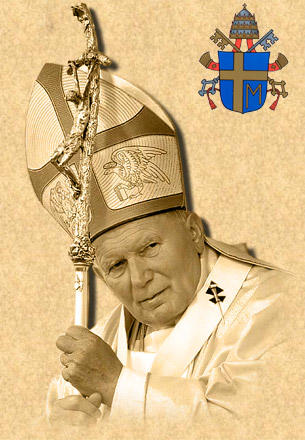


The weekend that His Holiness passed away, memories of long-ago thoughts, of people long-removed, yet omnipresent, flooded over me.
Dolores, this is for you.

IN MEMORY OF POPE JOHN PAUL II (1920 – 2005)

VIGOR
BY GEORGINA MARRERO

It’s raining outside.
Soft, at first:
Then torrents.
Then soft, again:
Then torrents.

The air is sweet.
Softly filled with the smell
Of the green grass
As it fills my nostrils
On this special day—

Vigor incarnate is leaving us.
Vigor as soft, sweet,
And torrential
As the rain as it descends
Upon the green grass—

As the vigor that helped
Lead us to the green grass…

Of Freedom.

Saturday, April 2, 2005

OCTOBER 16, 1978
BY GEORGINA MARRERO

On October 16, 1978, I climbed into my little Miami blue Volkswagen Rabbit outside my apartment at 1675 Massachusetts Avenue in Cambridge, and drove the nine or so miles to the Ezra C. Fitch School in Waltham. A bilingual teacher with all my credentials in place, I was, nonetheless, considered to be a tutor.
So was Mrs. Dolores O'Brien. In a warm, cozy, wood-paneled basement room congenially divided in the middle by bookcases, Dolores and I carried out our mission as Title VII tutors: she, as the English as a Second Language instructor; and I, as her Spanish Language and Culture equivalent.
No matter: we were two sides of the same coin, mixing, matching, and interchanging children over the course of the school day.
I'd arrived in the Boston area three years earlier. Although I had lived in New York for the three years prior to that, there's something about Boston that screams out, Irish. Perhaps it's the Kennedy legacy? Perhaps it's the Celtics… or now, more proudly than ever, the Red Sox?
Whatever it was, all I knew, back in 1978, was that a sea of Irish surrounded me, a little Cuban-American hybrid. Beginning, of course, with Mrs. O'Brien, her stories of her husband, Bob, and her daughters. I remember one was named Siobhan.
Dolores had been very warm and welcoming from the very beginning. We shared children, resources, funds-even an amused tolerance for our-as it turned out-less than scrupulous boss. She could always get a chuckle, a laugh, or even a hearty guffaw, out of me.
We decorated the room together, yet separately, in a happy style conducive to making our little Kindergartners through sixth graders feel at home. While I cluttered my side of the room with as many bilingual, bicultural visuals as I could get my hands on, I remember Dolores always had a calendar going. One with foliage, one with pumpkins, one with Santa Claus, one with flowers… and, of course, one with shamrocks.
For Mrs. O'Brien, of course, was Mrs. O'Brien. And, of course, there was also her good friend and co-conspirator, Mrs. Anna McMenimen. Mrs. McMenimen happened to be the school secretary, so Dolores was always in the know. Which meant that I was often privy to their flow of sometimes gentle, and sometimes picaresque, gossip.
Much of this gossip often centered on Miss Mary Furdon, our often exasperated, and much beleaguered principal. Exasperated is the operative word, here: if not Miss Furdon, then Anna. At least I knew how to approach Miss Furdon when I had to.
I have a super picture of the four of us and another teacher named Joyce, I think. Judging from the Santa Claus calendar in the background, one of the lovely, extremely artistic fraternal twins from Puerto Rico who graced our classroom as our student teachers during the fall of 1978 took that picture some time in December.
The Suarez twins might or might not have been there October 16, but Dolores and I were. It was a Monday.
News didn't travel as fast then, but I'm sure we heard while we were at school that day: Habemus Papam. We have a Pope: Karol Wojtyla.
A Polish Pope? I remember asking myself. Everyone was shocked-not just the Italians. I'm sure our little group at school discussed it.
Then I returned home to Cambridge and probably listened to the TV coverage. I may have been young - 24 at the time - but not that young that it didn't sink in.
A Polish Pope. What would it mean?
I hadn't really paid much attention to Popes, especially as a young child. After all, I was baptized at age four so that Castro wouldn't send me to Russia, along with other "unwashed" children. My equally hybrid parents didn't think of it, until then.
But they then rushed to include me as a little, yet significant, "aside" in the more "normal" baptism of my godparents' newborn daughter.
And, when we arrived in the States, I duly went to Catechism and celebrated my First Communion when I was eight. I still remember being terrified before my first - and only - Confession.
I also remember that the Pope at the time was a rotund man named John XXIII. Hard to forget, for me: XXIII. 23. My number.
The date was May 12, 1963. The Pope passed away just under four weeks later, on June 3, 1963. I'd been born during Pius The Twelfth's Papacy, but Pope John had been both my Baptism and First Communion Pope. So now, who?
I remember Paul VI as a slender, serious-looking, scholar. As I sporadically attended Mass, especially when I was directed to while I attended summer camp, I also, only sporadically, paid attention to him. But whenever I did, I gave him my full respect.
When he passed away and John Paul I ascended to the Throne of St. Peter, I was about to begin my second year as bilingual tutor at the Fitch School. Thirty-three days later - September 28 - was a Thursday. We must have heard the news of the new Pope's sudden demise while at school that day, too.
What was going on? I probably figured he had been infirm. Was the Vatican aware of his condition? I'm asking myself that, now, on the heels of learning about the conspiracy theories that surround his death.
The school was abuzz. I'm sure I sat in on many a discussion between, especially, Mrs. O'Brien and Mrs. McMenimen.
But here we were. The Conclave of Cardinals had reconvened, and a Pole named Karol Wojtyla had been named the new Pontiff. I remember the coverage about how to pronounce-let alone, spell-his name. John Paul II soon became much easier to handle.
What would it mean? We quickly found out. The new Pope visited his homeland. Solidarity. Lech Walesa. President Reagan: "Mr. Gorbachev, tear down this wall." I visited my aunt and uncle in a free Romania.
I now paid attention, albeit at a respectful distance.
Pope John Paul II ascended to the Papacy when I had just turned twenty-four. Twenty-six plus years later, he's gone. He will have been the Pope of my youth to early middle age.
Although I have never formally confessed, nor taken Communion, since my First Communion, there is a bond I have never been able to loosen. I remember only The Lord's Prayer, so I have to mumble along whenever I attend Mass, mimicking others. And yet…
… I could not help not taking note of the date - October 16, 1978 - when Karol Wojtyla became Pope.
And I could not help remembering where - and with whom - I was. With some lovely Irish ladies who were probably providing this hybrid with nourishment I wasn't even aware I was imbibing.
Rest In Peace, Your Holiness.
For Dolores O’Brien. Sunday, April 3, 2005

Sunday, March 16, 2008

Kinder if not Gentler


Paul Giamatti as John Adams, left; with his wife, Abigail Adams, as portrayed by Laura Linney.

HBO's mini-series, John Adams, based on David McCullough's biography, premiered tonight. I'm not going to say that it was perfect, but it was riveting and realistic. What I kept thinking about, though, was that those were kinder if not gentler times. Given all the political wrangling that's going on right now, especially the way that the Democratic Party stands a chance of tearing itself apart if it continues on its current path, both campaigns should take some time to watch this show; to be reminded of what it is that they're ultimately fighting to protect. The act of compromise has surely not been forgotten in modern times, now, has it?

Wednesday, February 20, 2008

The Twitch

Overtown in 1900

THE TWITCH

BY GEORGINA MARRERO

Do you know what it’s like to make a wrong turn when you leave Jackson Memorial Hospital, and end up in Overtown?

What I see is blight, and boarded-up buildings. A few stray people lolling about listlessly slumped against the sides of these buildings.

What I sense is despair.

What I feel is a twitch, an almost imperceptible twitch of something between shame and guilt.

“Why don’t they help themselves?” quickly becomes, “Why don’t we help them?”

Then I turn my car around, make the correct turn on 12th Avenue, and head back toward Eighth Street.

You know, where I come from, everyone’s pretty much alike. We might call someone “El Polaco,” or “La China,” and that person might pretty much be as white as the driven snow.

My father’s best friend had a great nickname: “El Moro.”

All right. So he was dark complexioned. We were taught not to care. However, when we got here, we learned about things like Jim Crow, segregation, and the KKK.

All we could do was shake our heads.

The Civil Rights Act stirred up a lot of Black Power, and made Afros fashionable. I’ve heard there’s a neighborhood in Atlanta where the homeowners and the gardeners have turned the Oreo cookie outside in.

However, here in Miami I can’t help noticing the envious stares; the sullen, angry looks; or, worse yet, the faces turned away.

My mother’s coworker told her many years ago that her grandchildren were being taught to hate us. “Why?” my mother very calmly, yet plaintively, asked. “Because. Just because,” responded my mother’s right arm.

They had enormous respect for each other.

I confess to the twitch: that brief, “How can they? How dare they?” And then it fades away into nothingness.

When I see the Overtown shacks, though, it lingers. It festers, and rebounds… all the way to my cozy cottage.

We know corruption. Art Teele knew corruption. He just wasn’t very good at disguising it, as an old-timer in my community informed me the other day, all the while wisely shaking his head. His cronies agreed.

Art Teele wanted to help his own. He did it the right way, and the wrong way.

However, his twitch rebounded throughout Miami.

So every day that I—that we—sit in our comfortable homes, let’s carry through on the twitch, a little bit at a time, a little bit more each day.

If not, that little “aah” that follows will smack more and more of hypocrisy.

Go take that wrong turn: you’ll see what I mean.

Copyright, 2005 by Georgina Marrero 425 words One-time rights


Tuesday, February 5, 2008

One Doctor's Dignity

Anne-Louis Girodet (de Roucy-Trioson) (1767-1824)
Raphael Urbain Massard (engraver)
Hippocrates Refusing Gift from Alexander
20.5 x 25.5 inches, sheet (Paris: 1816)

To Hillary Clinton and Barack Obama:

I would like you to read the following. I didn't write it--my mother did. She was Hungarian: a European-trained doctor who received her medical degree in Paris in 1940. One of her aunts had become the third woman doctor in Hungary (though she never practiced, as she married a wealthy man). My father--also a doctor--got her out of Europe in 1941; they proceeded to live in Cuba (my father's homeland) for the next nineteen years. I was born in 1954. In 1960, we arrived in the United States. My mother had been a housewife for twenty-five years when she decided to take the foreign medical exam--the ECFMG, as it was called--in 1965. We were living in Georgia at the time. She passed the first time; went on-staff at the state hospital in the town where we lived; and, in 1967, she began a residency in psychiatry. She was 54 years old. When she finished her residency three years later, she rejoined us in Florida. Two years later, when I went off to college, circumstances led to her landing a job at South Florida State Hospital. She was 59 years old. She worked at SFSH until she retired at age seventy. My mother was an extraordinary woman: principled; dauntless; with a privileged and exquisite mind. She was also extremely practical. She was also fascinated with politics; with current events; with progressive ideas, culling them from all of her constant and voracious reading. She was a true product of her generation, "The Greatest Generation," (she was born in 1913). She kept news clippings and notebooks about almost anything and everything. By the way, she voted for Bill Clinton in 1996, causing a severe rift with another member of her generation, a dear lady who's now in a nursing home (and who has forgiven her, I think).

Some time during the 1990's, she shared the following with me (and I haven't overly-edited: English was technically her fifth language): "About doctors." Among the many changes the world experienced through the 20th century, the changes of medical practice are among the most significant. Physicians used to be involved with the patients personally--they made home deliveries, home calls, they even operated on kitchen tables: simple things like tonsils and appendix. They often worked pro bono and in my generation who does not remember the old country doctor who often left a few dollars next to his prescription. The doctors listened to the patient and their families and they often smiled at each other. They were generally respected, trusted, and loved. Nobody ever heard of suing the doctor and the insurance was not a major issue. Now everybody is covered by insurance (or else!). The doctor is secluded in his office, surrounded by assistants, submerged in paperwork and technicians, (who are) performing procedures and even "examinations." The first thing requested from the patient is not a list of his complaints, but to fill out forms concerning the type of their insurance, their SS number, etc. The P.E. (physical exam) is minimal, technicians and technology replaced the Hippocratic methods. Errors are more frequent than when the practice was more personalized and Malpractice--the big M--often caused by negligence, and sometimes by ignorance is more prevalent. Accidents and human error always existed, but we used to remember the saying "Errare humanum est." Now we think more in terms of suits than philosophical concepts. A special chapter should be dedicated to the Medical Business proper, directed by the owners of HMO's, Hospitals, etc., limiting the physician's humanistic role and his income, but not his responsibility. And let's face it, in spite of technicians and technology; in spite of the so-called Medical Business, Doctors are still needed. Who else could sign your death certificate?

-- Ana R. Marrero, M.D. 1913-1999

Thank you for reading.

Friday, February 1, 2008

Rosa

Last Wednesday was Panni's birthday. I was otherwise engaged. Perdoname, Mami.

Here's a La Loquita vignette I've never published before. Bring out your Spanish dictionary!

LA LOQUITA DEL ZIG-ZAG: ROSA

POR NININA MAMEYEZ

Olor a rosa (el perfume francés de mami); las rosas del vecino; Los Zapaticos de Rosa (El Gran Patriota); La Gran Tienda – comprando mas perfume de rosa (la vendedora se llama Estrella), no le queda mucho a mami, porque Ninina se lo ha estado poniendo, todo; asi que mami le compra una botellita solamente pa’Ninina, aunque ella olfatea a muchas otras (PEE-U!); abuelita (se llama Rosa); peo – uh, oh! – pero, al final, lo más importante es el pollo rosado...

UMM! UMM! Estaba olfateando a las rosas de nuestro vecino, el señor Gonzalo. Olían tan bien, y tenían colores tan bonitos: rojas; blancas; y, claro, rosadas. Estaba al punto de cogerme una, cuando se apareció La Súper-Planchada.

NININA! Que estas haciendo? Uh, oh. Nada, tata, nada. Pues, ven conmigo. Tu mami te quiere ver. Y me halo de la mano pa’la casa.

NININA! Ay, otra vez. Que has hecho? Uh, oh. Nada, mami, nada. Solamente estaba olfateando a las rosas del señor Gonzalo.

Tu y tus rosas, niña! Mira, me iba a poner mi perfume francés de las rosas, y descubrí que casi no me queda. (Mirándome.) Tu sabes por que-e?

Uh, oh. AY, sí, mami. Me lo puse el otro día antes de ir a casa de Ofelita, verda?

Y cuando fuimos al cine. Y cuando fuimos al museo, y al zoológico, y al...

Ay, nene. (Riéndose.) Claro. Te gusta a ti, porque me gusta a mí. (Riéndose, otra vez.) Verda?

La mire. SÍ! Pues, m’ija, creo que tenemos que ir a La Gran Tienda. Chino, llévenos, por favor.

En La Gran Tienda, empecé a volar de vitrina en vitrina. AY, mami, como hay perfumes aquí! La vendedora me miró, y me preguntó, “Quieres probar algunos perfumes, niñita?”

SÍ! La señora echo un poco de perfume encima de pedacitos de papel. Los olfatee a todos.

AY, QUE RICO! Me gustaron cuando olían a mi talco de bebe. PEE-U! Algunos eran muy fuertes. Hice una cara cómica – la señora se rió.

Mami me estaba mirando. Como te pareces a mí, hijita. Y suspiro.

Señora, por favor entrégueme el perfume francés de las rosas. La señora sacó a una botella de la vitrina. Mami lo pensó, y siguió: dos botellas mas, por favor.

Ninina, mira! Te estoy comprando una botella del perfume francés de las rosas, solamente para ti. AY, mami, gracias! Y otra mas, para tu abuelita. Acuérdate de que ella se llama Rosa.

HEE-HEE. Sí, mami. Podemos ir a ver a los libros, también? La señorita Zina dice que yo ya puedo leer MU-CHO...

Subimos al segundo piso. Al lado de los juguetes, y esa casa de muñecas, estaban los libros. MIRA, mami, Rosa!

Mami le dio un vistazo. Pues, sí, Los Zapaticos de Rosa. Sabes quien lo escribió, nene? El Gran Patriota. Abriéndolo, mami y yo empezamos a leer: “Yo voy con mi niña hermosa,” le dijo la madre buena. “No te manches en la arena los zapaticos de rosa!”

Que bien, Ninina! Cómo has aprendido en la escuela! Me dio un beso, y me compró el libro.

Gracias, mami. Pero, tu sabes que? Yo nunca mancharía zapaticos de rosa. Nunca!

Me imagino que no, nene. Vamos a bajar ahora, ok? Me aguante de la mano de mami, porque no me gustan las escaleras mecánicas. Una vez vi a alguien caerse.

Y todavía les tengo miedo. Pero menos, porque ya soy GRANDE.

Chino nos devolvió a La Nueva Ventana. Fui volando a mi cuarto con mi perfume francés de las rosas y con mi librito de los zapaticos de rosa.

Porque mi rosa favorita me estaba esperando. Mi pollo rosado.

Es propiedad de Georgina Marrero, 2005 522 palabras

Sunday, January 27, 2008

The Little Black Hat

In 1964, when I was ten years old, I paid attention to a man from the other side of the world who was wearing a little black hat. His name was Sukarno. He was overthrown by another man with a little black hat. His name was Suharto. He passed away earlier today.

For what it's worth, it was that little black hat that opened me up to my interest in Indonesia. What a ten-year-old pays attention to, eh?

Tuesday, January 22, 2008

So Sad


Heath Ledger was brilliant as Ennis Del Mar in Brokeback Mountain. As good as Phillip Seymour Hoffman was in Capote--and he was--in retrospect, shouldn't Heath have won (and I wanted him to)? I'm sad. Oh, so sad. Twenty-eight years old? He'd barely begun to live...